little southern country
by ashley fung
The restaurant sign reads ‘Southern Mini Town Restaurant’ in a small font just below its Chinese characters. Surprisingly, the English name is not too far off from 小南國 (Xiǎonánguó), which translates to ‘little southern country.’ Unlike most Chinese restaurants, where owners claim the name Chang’s Garden, Delicious Food Corner, or Seafood Palace, none of which have any correlation with the true meaning but successfully attract some of their Western customers, more comfortable with a bowl of pasta than a bowl of egg drop soup, Xiaonanguo remains authentic inside and out.
The space itself is small. It comfortably fits eight tables of four and uncomfortably squeezes four tables of eight. One wooden table is always left bare, without a table cloth or lazy Susan, for the staff of five to take their breaks. I’m convinced that our family dinners exceed max capacity, pushing the walls to their limits and forcing the two waitresses to weave through customers’ chairs in the same way one would an obstacle in a game show. A row of excess chairs line the entire right wall, pushing the tables more towards the center of the room as if to say, “there’s room for more if you need it!”
The top half of one of the rectangular dining room’s side walls is covered with mirror panels. Conveniently, guests can check in on how they’re looking in between courses and people-watch the rest of the room without having to turn around and point. It is more likely that the owner decided to keep or install these panels to create the illusion that the space is larger, but the aforementioned benefits are just a couple of examples of how my family has utilized them through the years.
In the back left corner is a sturdy lectern which the cash register is tucked into. Although I’ve never stepped behind, I know it’s also where they keep the stash of plastic bags and
styrofoam to-go containers that the waitresses never fail to bring out after we’ve inevitably realized there is such a thing as too much food. A small T.V. hangs directly above, sometimes playing local news and most times playing an NBA game at full volume.
Just across the street, the neighboring food plaza houses one of the 487 El Pollo Loco locations scattered across the United States. Xiaonanguo’s surroundings are not picturesque by anyone’s standards, but I have never found it too appetizing if a restaurant’s best qualities are its views.
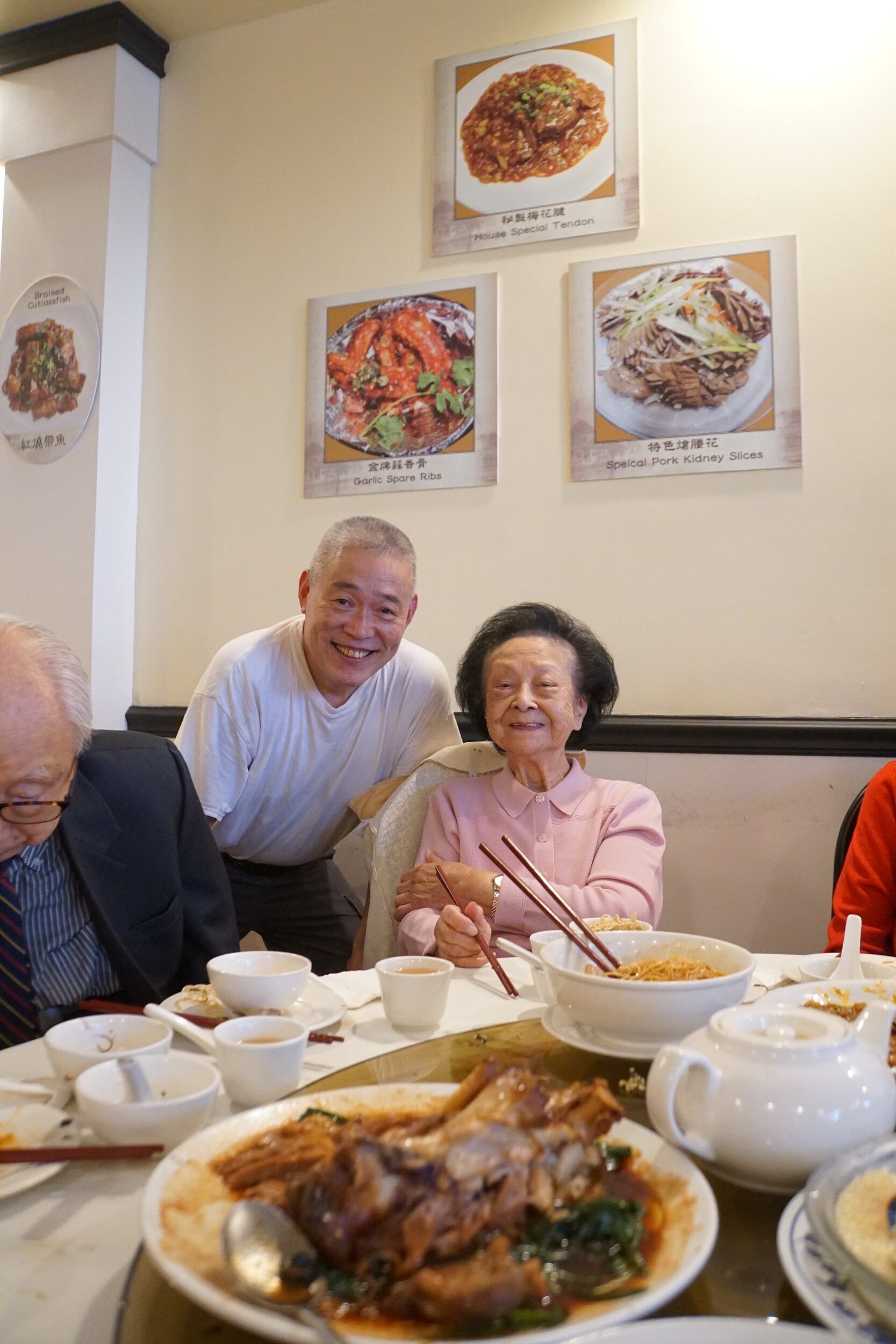
The owner and chef is a Shanghainese man in his mid 60s. He is never not smiling from ear to ear unless he is out front, reclined on one of the four foldable metal chairs taking his smoke break, exactly where I found him for my first meal at Xiaonanguo. His more-than-modest uniform consists of dark grey slacks and a tucked-in white cotton tee, adorned with splashes of oil. When it’s over 80 degrees, he’ll ditch the sleeves and go for a casual tank. Sometimes he keeps the apron around his waist to greet us, sometimes he doesn’t. There are no hard and fast rules when you’re the owner.
We call him 老闆 (Lǎobǎn), the Chinese word for ‘boss’ or ‘owner’ that instantly commands respect and suggests familiarity. I have no idea what his name is, first or last, nor have I ever asked for it. Some would say that’s ignorant given how frequently we dine at his restaurant, but in reality, this level of ambiguity perfectly reflects my family’s relationship with him. We are comfortable enough to text him our order ahead of time and consider it normal when he takes a seat next to my great-grandma during dessert to ensure he added enough sugar to accommodate her sweet tooth, yet the conversation never really goes beyond the topic of food.
Nevertheless, I was uncomfortable with the fact that we knew so little about him. He was running a business, sure, but in my mind, the dynamic shifts when grandma has his personal phone number, should she ever unexpectedly need to change the dinner reservation to 20 people as opposed to the usual eight.
Admittedly, I recruited my grandma as backup for translating the questions that surpassed my barely conversational Mandarin-speaking abilities in difficulty. Not only is Mandarin my second language, but it is also Laoban’s, as his native tongue is Shanghainese. Mandarin is often referred to as 普通話 (Pǔtōnghuà), or “the common speech” because it has been the official language of China since the 1930s. Shanghainese is one of many Chinese dialects, which all share the same characters, but are almost entirely different in speech. While those who are
exposed to one dialect are more likely to learn the sound of another faster than an English-speaker, you could be sitting at a table with one Cantonese, one Shanghainese, and one Mandarin-speaking person only to find that no one can understand each other. My maternal grandmother was born in Shanghai, but since her parents escaped to Taiwan with her after World War II, Mandarin became the dominant form of communication for her side of the family.
We drove from my grandma’s house, two blocks away from mine and less than five minutes away from the restaurant, so close we usually drive back if we mistakenly arrive half an hour before others for dinner. On most days, parking requires strategy. Claiming a spot is no easy feat as Toyota minivans roll into the parking lot entrance, unbothered by the fact that their side-view mirrors probably just scratched the car going out. The plaza’s parking lot entrance is so small that it really should be one-way only. Given our close proximity to Xiaonanguo, though, there is little we can complain about.
We arrived for the interview an hour before 5 pm, when the restaurant was scheduled to open, to give Laoban enough time to prepare for that day’s dinner rush. Despite it being a hole in the wall, I’ve never seen Xiaonanguo so empty. The hum of the lights began the moment he turned on the switch, unlocking the front door and walking in the same way we all do.
Laoban is a man of few words, or at least when he is talking about himself; a conversation about basketball or soccer could take you in an entirely different direction. He kept his answers brief, but the consistent smiles after each sentence were signs of reassurance as if to tell me that we could continue. In any culture, there is a fine line between work and personal relationships, and I dared not cross it. While most of my family was more than comfortable with Laoban, I mostly stood on the sideline of every conversation. To him, I was nothing more than
my grandma’s daughter’s middle-child, so it seemed appropriate not to ask anything too invasive.
Unsure of his willingness to share, I decided to kick-off the conversation by asking about Laoban’s history with food. His favorite dish(es) to cook included anything from his menu, a cop-out answer in my opinion, but acceptable for the purpose of breaking the ice. Recognizing my dissatisfaction, he let out a quick laugh, more of an exhale really, and told me that the most difficult to prepare was easily the Special Pork Kidney Slice, my mom and dad’s favorite.
The dish is not exactly appetizing at first glance, and it is even less so when you tell people which part of the animal it is. The meat has a chewy consistency, so much so that the time it takes to swallow is enough to make you question whether you enjoyed it or not. I do not consider myself a picky eater, nor do I find myself easily phased by the thought of consuming less traditional animal parts. Give me a plate of spicy pig ear and I’ll dig in, but something about the Special Pork Kidney Slice hasn’t won me over.
Even the name suggests the kidney is hiding something. The English translation attempts to mask the oddity of the dish, but slapping on “special” to the front doesn’t have the same framing effect one might hope for. In order to soak up all of the salt from the water when boiled, the kidney must be cut in a criss cross fashion. The dish’s Chinese name argues that such delicate cutting resembles a 花 (huā) or flower, expanding on the Special Pork Kidney Slice’s deceiving cover-up.
Some part of me felt bad for Laoban, asked to prepare the most challenging meal by his most frequent customers, but I quickly learned that what he loves most about cooking the food is watching people enjoy eating it. Ever since he was a child, he loved cooking. Having perfected his craft at the Shanghai Culinary School (not the official name, but he didn’t care to elaborate
and I didn’t care to pry any further) in 1979, Laoban dreamt of opening a restaurant and didn’t want to stop until he did. In my mind, the most coveted sign of approval comes from my 100-year-old great grandma. She eats at Xiaonanguo once, if not twice, per week, so if she says Laoban’s cooking is better than some food she had growing up in Shanghai, it must be true, right?
My great-grandma, Bubu, has been back to Shanghai no more than five times since she left at the age of 22. As I briefly mentioned before, she and her family, my grandma just two-months-old at the time, were left with no other option but to leave when the Chinese Communist Party took over in 1948. She’s lived in Taiwan for the majority of her life and moved to the U.S. to join my grandma and mom in the ‘80s, but to this day, she considers Shanghai home. Growing up, Bu was the chef in our family, catering to each of our distinct preferences until it became too difficult to stand by the stove for extended periods of time and her arthritic hands prevented her from washing, chopping, and stirring the way she wanted to. From what I can tell, she liked cooking, or, similar to Laoban, she liked that we liked her cooking. But at Xiaonanguo, you can tell she’s completely stress-free. Laoban’s cooking is objectively extraordinary, but something can also be said about the fact that at Xiaonanguo she gets to speak her own language and eat her favorite foods.
If anyone asks me about where the best Chinese restaurants are in Los Angeles, I never fail to reply “San Gabriel!” Almost always, I’m met with an expression of doubt. In most big cities—Chicago, New York and San Francisco—Chinatown is the place people, Asian or not, go to for dim sum, boba, and a solid bowl of beef noodle soup. This celebration of food and culture, however, was not the original intention for Chinatown. At least in San Francisco, around the mid-1800s, Chinatown was the neighborhood immigrants were pushed into when their presence
and ready-for-anything labor force threatened the already weakening American economy. While San Gabriel Valley holds similarly unique historical significance in the city of Los Angeles, home to many of the Japanese, Chinese, Filipino, and Southeast Asian immigrants that came to America in the mid-1800s, some have described it as the result of choosing rather than being told where to live. Unofficially, it is considered to be made up of several “ethnoburbs”: suburban areas in which a particular ethnic minority makes up the majority of residents and business owners.
There was a time in my life that I was embarrassed to say San Gabriel was my hometown. In conjunction with my fascination with the romanticized stories of West L.A. and Hollywood, it was difficult to wrap my head around why my parents decided to settle down in
San Gabriel once my older sister was born. Why didn’t they want us to go to school with Sylvester Stalone’s daughters like some of our friends?
Their answer was simple, and has remained unchanged ever since the first time I asked. “We wanted you three to have the best of both worlds. There is a reason we came to the U.S. for college and decided to stay. You were born in America, so we will raise you American, but we don’t want to sacrifice the type of food and languages we were exposed to when we were kids. San Gabriel puts us in the perfect spot, right in the middle.”
Early on, I dramatized my perfectly happy childhood and interpreted my Chinese heritage as something I needed to hide, likening my experience to Hannah Montana’s. At the time, I didn’t grasp how lucky I was to experience two lifestyles, two languages, two supermarkets—one with endless rows of cereal and potato chips and the other with bins of fresh lychee and live frogs.
Now that I spend most of the year away from home, I’ve developed a much deeper appreciation for everything it has to offer. Besides missing family, I have found that my strongest tie to home is the food. I was so used to coming back from school to freshly baked 菠蘿麵包 (bōluó miànbāo), pineapple buns, on the kitchen counter that my mom continues to send multiple USPS flat-rate packages full of them whenever she finds the time. The same applies to Asian pears (yes, they do exist and no, they are not pear-shaped).
I am not known to be a picky eater and enjoy taste-testing new restaurants as much as the next person, but the rich tastes and distinct smells of Chinese food will always be my comfort. It is Xiaonanguo that I crave when I get off the plane from LAX, something I can only find at home.
Home for Laoban is the United States, not China. It’s difficult to pinpoint exactly when he arrived in California. In fact, it wasn’t until I put him in a position to reflect on it that he realized he has since forgotten the reason why he came in the first place, but he enjoyed life here and thus decided to stay. I was surprised to hear how simple his story was, and that he had no desire to go back to his motherland. I wondered if he truly forgot about what led him to the U.S. or if he, more likely, was hesitant to share any more personal details. My mind was blurred with preconceived notions of the Chinese immigrants who populate San Gabriel without ever really conversing with one. I assumed everyone shared similar stories to my great-grandma, pushed out of their home and forced to look for a better life in a foreign country.
In my notes, I had written “Where is home for you?” “Why did you move to the U.S.?” “Do you ever want to go back home?” in this exact order. Evidently, I was under the assumption that home for Laoban would be China. I asked these questions half-expecting to hear a similar story to my grandma, who sought a better education, career, and lifestyle opportunities than what
was offered to her in Taiwan. I never thought about how I would react or where I would take his story if he gave an alternative answer.
Laoban couldn’t have put it more simply: he moved, he lived, and he stayed. In more ways than one, his relationship with both food and America, simple as they may be, matches that of many other immigrants. What separates him from the rest, however, is his nonchalant attitude towards the impact of the pandemic on his own business.
I’ve always been well aware of the fact that, if the Lakers are playing, there’s a good chance we won’t be eating at Xiaonanguo. Taking off a few nights to root for your team is passionate, but shutting down for nearly a year seemed impossible.
The whole world suffered from the turmoil COVID-19 put people through, and small businesses, especially within the service industry, seemed to be hit the hardest. Mask mandates and vaccination requirements have forced owners to choose between the safety of their staff and the opportunity to get back to work when all anyone craves is a taste of normalcy. Laoban defied all odds and managed to close Xiaonanguo for the duration of lockdown.
My grandma and I are both unsure about how Laoban made a living in China, and whether or not he could live comfortably without Xiaonanguo, but that seemed like a detail that could stay left out in an effort to preserve some privacy. He never explicitly told me this was the case, but I can only assume making people happy via food was not worth the risk of hospitalization.
As we got up to leave, all three of us pushed our chairs into their respective round dining table as if doing so would make the room look a little less crowded. In sincere but broken Chinese, I expressed my gratitude for his time and Laoban, as usual, smiled from ear to ear and waved goodbye with his back facing us as he walked towards the kitchen. Just
before he turned the corner, Laoban shouted something in Shanghainese. Stuck with my limited vocabulary of thank you, see you tomorrow, and see you later, I anxiously looked to my grandma for help. She finally relieved me of the suspense once we got in the car: “He said we didn’t have to come all this way. He doesn’t know why you’d want to write about him, but he hopes it was all helpful.”
I originally took interest in Laoban’s story because I simply enjoyed eating his food. His was the first vegetable dish that I ever asked for more of. It’s nothing more than a mix of finely chopped tofu and greens, but my mom claims it’s difficult to master. To this day, he doubles the standard portion size and has it on the table before we sit down. Irrespective of any language barrier, Laoban carefully crafts relationships with the people who dine at his restaurant regularly, his fan club. Post-smoke, he never fails to check in on each table to make sure everyone’s favorite dish made it to their stomach, only returning to work after seeing everyone smile in-between chews.